Browsing the archives for the inequality tag.

Bennet’s been there

Culture, Politics, US culture, US Politics

The New Yorker is a pricey purchase here in Central Europe, but every so often I make it anyway, because its in-depth reportage is often unparalleled. One such piece of reportage I still vividly remember one or two years later dealt with valiant efforts to reform the education system in Denver. Nominally, at least. In truth, it was a both heart-wrenching and challenging panorama of how deep the roots are of the inequality of educational opportunity, and the problems of poverty, exclusion and ghettoisation that underlie it.

Even as the article covered chunks of policy debate, it didn’t get abstract and made you feel the human challenges involved. It resonated with personal experience, and I felt like forcing people to read it. Foremost those with glib answers about poverty and how people should just get themselves to work and pull themselves up by their bootstraps. It sounds stupid when you try to explain that even just getting yourself to another part of town for a job or better school can be an insurmountable obstacle if you’re – well, fill in your cliché – on the outside. But this article made you feel it.

Reading it you couldn’t help identifying with the Schools Superintendent who was trying so strenuously to make sense of it all, and to undertake a daunting effort, from the ground up, to make changes that would spread the benefits of education beyond the middle class.

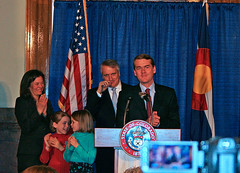
Michael Bennet with family and, behind him, Governor Ritter. (Image used under CC license from Jeffrey Beall)

Michael Bennet with family and, behind him, Governor Ritter. (Image used under CC license from Jeffrey Beall)

Well, that Superintendent, Michael Bennet, last week was selected by Colorado Governor Ritter to take Ken Salazar’s seat in the Senate.

All I know about him is that New Yorker article. Taniel at Campaign Diaries, however, explains that “Bennet looks to be among the most centrists of Ritter’s potential choices” and that “Ritter himself emphasized Bennet’s centrist politics, describing him with the “postpartisan” terminology that has become the cloak of the ideological center.” Practical, pragmatic, not dogmatic, that kind of thing.

Bennet himself pledged to follow in Salazar’s “bootsteps”, which are distinctly conservative for a Democrat. In short, the Bennet pick will “be frustrating progressives”, and he might oppose card check. Not exactly encouraging stuff.

And yet I can’t help feeling happy about the pick. Such is the power of good journalism. Happy except, of course, for the fact that the man will now no longer be heading Denver’s school system. When one of the major problems with the efforts there have been to improve the school system is inconsistency. The lack of follow-through: a burst of activity as the latest reform model is implemented, and just as effects start moving some of the intractable problems, a change in regime or a new model. Maybe you should make Schools Superintendent as prestigious a position as US Senator …

1 Comment

“What a Progressive President Might Say”: How will Obama match up?

Politics, US Politics

I didn’t have any spare online time the last week or so, so I’m no longer current on the latest transition news. This was a good find just before, however. After it was confirmed that Melody Barnes would be the Director of the White House Domestic Policy Council under President Obama, TNR The Stump dug up a link to an op-ed she wrote in January 2007 for the WaPo — which was framed as the State of the Union address a progressive president might give.

She gives fashion advice too.

She gives fashion advice too. Not kidding - the Washingtonian profiled her as one of "Ten Well Dressed Women".

Most striking about the piece is just how on message she already was for what would become the framing of Obama’s candidacy and presidency. No wonder she was picked for a top post.

Most encouraging is how she placed escalating income inequality right at the top of domestic policy priorities. What’s hopeful in particular is the way she presented it as the container issue through which other domestic policy questions are framed. Tackling the rapidly increasing concentration of resources in the hands of the few is not just a question of upping the minimum wage. It’s the basic challenge of socio-economic policy that major social issues like education and health care all tie back into.

The acknowledgment of this in Barnes’ piece does warm the progressive heart – both the urgency with which she posits the issue and the ability (and political will) to contextualise pressing sectoral issues like health insurance as more than just individual issues that have come up. Implicit is the understanding of these issues as part of a broader failure of the market economy, or at least of the lurch toward an ever less regulated market economy since the eighties.

A somewhat disappointing part of the piece is the contrast between the paragraphs on Iraq and health care. In both cases, the general diagnosis is solid. For Iraq, however, there is an unambiguous plan of withdrawal. On health care, on the other hand, it’s mostly what’s not mentioned that’s interesting. What to do about the uninsured? Who should ensure them? A state program or private insurers? If a state program, one that’s open to all, or just those without coverage now? Funded how? And if private insurers, how would they be compelled to do it? What about mandates?

A State of the Union obviously doesn’t need to dig way into the details, and a brief op-ed posturing as one cannot possibly do so. But some idea of what path of action she was imagining would have been instructive, especially since her portfolio will include health care and education.

The same goes for energy. The op-ed raises all the right points, but it’s wildly vague on courses of action and priorities. While the paragraph on science underneath includes a pointed reference to embryonic cell research, there’s nothing in the way of even a general approach (say, cap and trade) here.

Still, the fact that one of the top domestic policy advisors to President Obama actually authored an op-ed specifically imagining a progressive presidency is definitely encouraging. Barnes comes from the Center for American Progress, which might calm some nerves about the lack of progressive Obama appointments. The post she will fill is potentially a very powerful one. Now the only question is, what kind of influence will she be able to exert?

1 Comment

Spread the wealth? What Americans think

Economy, Politics, Presidential Elections, US Economy, US Elections, US Politics

In my post, after the third presidential debate, about McCain’s efforts to make “spreading the wealth around” sound like the most ominous thing, I quoted Ezra Klein as saying that “for most folks, spreading the wealth around probably seems like a good idea” right now.

This is correct, Brian Schaffner of the CCPS argued yesterday at his new home on pollster.com. Taking as lead how the ABC/WaPo poll hasn’t shown any movement this month on the question which candidate is trusted more on the question of taxes, he digs up data showing so from a 2003 survey conducted by NPR, the Kaiser Family Foundation and the Kennedy School of Government.

Moreover, in case you’re feeling doubtful about those sponsors, the same thing is largely confirmed by Gallup data, which the polling firm’s in-depth look at the issue on Thursday revealed.

Schaffner argues that the McCain camp’s insistence that Obama’s proposal to raise taxes on the top 5% of income-earners smacks of class struggle and socialism doesn’t drill into much of a popular perception. It isn’t surprising “that McCain hasn’t gotten much traction by criticizing the fact that Obama wants to increase taxes for high income Americans,” Schaffner writes, because the 2003 survey actually showed that most Americans believe “high income people pay less than their fair share”. Over 60% of Independents, over 70% of Democrats and even a plurality of Republicans  agreed. Barely over 10% of independents and some 30% of Republicans, on the other hand, thought that high income people “pay more than their fair share”:

The Gallup polling data doesn’t directly address the question whether wealthy Americans pay enough taxes, but it does show a majority of Americans believing that “the distribution of money and wealth in this country” isn’t “fair”. Throughout intermittent polls in the last twenty-odd years, an ample majority opined that wealth should be “more evenly distributed among a larger percentage of the people,” while just 27-37% believed that the current distribution is fair:

Two details strike me in this graph. The opinion that “spreading the wealth around” seems like a good idea isn’t just something that’s coming up “right now”, in the face of a financial crisis; it’s actually been pretty consistent through the years. But there’s two kinds of variations over time.

Continue Reading »

1 Comment

Sometimes a chart is worth 1,000 words

Economy, Politics, US Economy, US Politics

This one comes via Kevin Drum at Mother Jones:

GDP growth vs. median wage stagnation

Yes – between the beginning of 2002 and the end of 2006, the United States GDP grew by over 15% – while the median wage flatlined, not going up by a single percent. In short, the country got ever richer – but the middle class saw nothing of that wealth. It was pocketed in its entirety by the wealthiest, with an assist from the tax cuts that the Bush administration heavily slanted in their favour.

Are there any recent historic precedents of such a disconnect, in which double-digit national economic growth was not accompanied by any improvement whatsoever for the average American? Was it this bad under Reagan, or Thatcher?

Pondering these numbers, Drum approvingly quotes an article by Joe Klein on Time’s blog Swampland: “We have had 30 years of class warfare, in which the wealthy strip-mined the middle class.” He adds:

For three decades we’ve artificially kept middle class wage increases far below the growth rate of the economy, and this trend has been even more pronounced over the past eight years. This has created an enormous pool of extra money that’s been — yes — strip mined and redirected to the rich, and fixing this is Barack Obama’s biggest and longest-term challenge.

If we restore the normal growth of middle class wages, it provides a sustainable consumer base for the entire economy; it reduces the demand for endless credit card debt; it brings down income inequality naturally; and it goes a long way toward keeping the financial sector under control and reining in Wall Street salaries without putting in place a bunch of artificial (and probably fruitless) regulations. [..] Stop the strip mining and economic vigor will follow. It’s at the core of everything.

UPDATE: Lane Kenworthy, a Professor of Sociology and Political Science at the University of Arizona, had a blog post earlier this month that traces the trend further back, to the Reagan era: Slow Income Growth for Middle America (h/t to A2K user Hawkeye). The pattern is pretty devastating – and he’s got a telling graph too:

Continue Reading »

4 Comments

Spread the wealth around!

Debates, Media / journalism, Politics, Presidential Elections, US Economy, US Elections, US Politics

One of the oddest features about Wednesday’s debate was John McCain’s repeated, dismissive references to how Obama wants to “spread the wealth around”. McCain repeated that line no less than nine times, each time derisively, and nine times is a lot in a debate like this. In comparison, he mentioned “education” six times, and “health insurance” three times (which Obama mentioned ten times).

(By the way, if you’re looking for Wordles of the two candidates’ words during the debate, like the ones I made for the second debate, check out these ones that Flickr user spudart made.)

I was actually looking whether there was a YouTube video splicing together all his “spread the wealth around” lines. Because if I knew how to edit videos, I’d make one. I mean, just go to the wonderful NYT interactive election debates tool, type in “spread” in the neat search box above the coloured bars, and use the forward and play buttons to the right to switch between all the references. It’s wonderfully bizarre. (OK, maybe you have to be a geek.)

M J M

Wages have stagnated for a decade .. For most folks, spreading the wealth probably seems like a good idea. (Image used under CC license from Flickr user M J M)

The weird thing about these invocations is that, as Noam Scheiber pointed out, he “repeatedly invoked Obama’s line about ‘spreading the wealth around’ without explaining what makes it so offensive (beyond his own menacing tone).” As Scheiber adds, “it didn’t strike me as self-evidently damning.” Right. I mean, God forbid anyone would want to spread the wealth – give other people a shot at it too. As Ezra Klein adds, “Median wages have stagnated for a decade … For most folks, spreading the wealth around probably seems like a good idea.”

McCain got the quote from Obama’s answer to “Joe the Plumber” (who isn’t actually a licensed plumber, doesn’t actually make $250,000 and wouldn’t have to pay higher taxes under Obama’s plan even if he did buy that company), when they met during a campaign stop. It’s worth watching the whole answer Obama gave. There’s nothing particular controversial in his answer as a whole, and the “spreading the wealth” line came in the context of giving people who are where Joe was earlier in his life tax cuts so they would be helped making it too. But as Campaign Diaries points out, the McCain campaign wants you to see the line as “code words for socialism”.

The thing is that McCain didn’t actually bother to make that argument in the debate. He appeared to think that just repeating the line would make people go, “oh yeah, that’s terrible – spreading the wealth around, how can he say such a thing – he must be a socialist”. This equation strikes me as typically one of those things that only works within the bubble. Maybe because for most people, a $250,000 income is so far removed from their world, they can’t even imagine. After all, it’s just the top 3% who earns that much. It’s five times the median household income, and eight times the median individual income.

It is not far removed, however, from the lives of those reporting on politics for us. For network TV reporters, for pundits and politicians, for anchormen and talk show hosts, it’s not that much. They do know people who make that much, because they are often among the top earners in America themselves. So for them, it hits close to home. And because pundits and anchormen hang out with other pundits and anchormen, their view of what is normal is warped – for a striking example see the video below the fold. And this has serious consequences for the opportunities to market liberal economic policies.

Continue Reading »

3 Comments